

By Jamie Shinhee Lee
I didn’t like GenAI. Not one bit. I had zero experience with it, zero interest in it. I was a
total skeptic. Maybe that’s why Hub’s (Teaching and Learning Resources) seven-week
GenAI program picked my application from a crowded pool of hopefuls. (The Hubsters
told us they received over 55 applications.)
My skepticism wasn’t born yesterday. It comes from years of academic training in
sociolinguistics, where we study human communication in all its messy, beautiful,
context-rich glory. We celebrate the quirks and variations in how people speak, which is
why my first discussion post in the seven week program, read: “I have more faith in
humans than in machines.” To be fair, I have my reasons. A few personal experiences
have only reinforced my doubts about the capacity of machines to handle
communication effectively.
Take my first GPS, for instance. As someone perpetually challenged by directions, I was
thrilled when navigation systems hit the market. I spent $210 on one and thought it was
one of the best investments of my lifetime. For a while, it was—until I drove to my
friend’s house in Toledo, OH. I couldn’t help but laugh when my GPS pronounced
“Toledo” with the stress on the first syllable and a different vowel: TAledo rather than
ToLEdo with the rounded vowel locals use. While the voice was beautiful, the lack of
consideration for local pronunciations was disappointing and, to the sociolinguist in me,
even unacceptable.
And then there was the infamous phone-service fiasco. You know the type: the chirpy
automated voice that says, “I’m sorry, I didn’t get that,” on repeat until you start
questioning your existence. When it happened to me, I initially thought my Korean-
accented English was to blame. I took it personal. “Is my ‘yes’ so accented it’s
unintelligible?” I wondered. This was years ago, and I hope that technology has since
made significant strides. These small frustrations, however, contributed to my enduring
skepticism about non-human communication.
My skepticism, however, wasn’t just personal—it was professional. I had this gnawing
fear that students would abuse AI to avoid actual learning, treating it like a magic
homework genie. As a result, my usually exhaustive syllabus (6–8 single-spaced pages,
thank you very much) conspicuously lacked a GenAI policy. Why? Mentioning it felt like
inviting trouble—or at least a little too much “help.” I feared that even mentioning it
might encourage students to take shortcuts rather than engage actively with their work.
My concern about AI, particularly its potential for misuse in the classroom, is not
exactly a lone sentiment. Faculty members at other institutions are on the same page.
According to The Harvard Crimson, “nearly 60 percent of faculty respondents from the
Arts and Humanities division said they felt AI would have a negative impact.” According
to D’Agostino (2023), faculty members are divided regarding the role of AI in teaching
and learning. Academics who value evidence-based arguments naturally feel uneasy
about AI because “research on teaching and learning with generative AI tools is in its infancy.” One faculty member interviewed in D’Agostino’s (2023) article sums it up
perfectly: “AI has brought up very visceral feelings about academic integrity.”
Now, let me share how my skepticism started cracking bit by bit during the seven-week
program, leaving me on a mission to embrace a healthier, more balanced, and open-
minded approach to GenAI—skeptic turned explorer, if you will.
Each week introduced a different tool or theme, with hubsters rotating and facilitating
activities and discussions. I found all the topics useful, but the first three sessions were
particularly beneficial to me because they introduced the fundamentals of GenAI, which
I lacked at the time. As a result, I was able to implement some changes in my teaching
or, at the very least, consider ways to improve certain aspects of my syllabus and course
materials. The workshop gave me practical tools I could test out during in-class
activities and those weekly assignments that kept things real. For instance, the concept
of ‘prompt engineering’ taught me various ways to craft prompts by tweaking three key
factors: role, audience, and purpose. We were reminded of the importance of being
specific about the desired output. Additionally, we had the chance to stress-test an
actual assignment from our courses to see how challenging or easy it was for GenAI to
complete. We then role-played as students to explore the kind of output they might
receive.
The workshop’s pedagogical focus and student-centered approach were particularly
evident in the second week’s session, in which we explored various pedagogical lenses
and issues, including project-based learning, culturally responsive teaching,
metacognition, social and emotional learning, real-world relevance, and more. Using
these different pedagogical lenses, GenAI provided concrete suggestions and
modifications to enhance the effectiveness of some of the activities and assignments we
use in our courses. For instance, I applied the “culturally responsive teaching” lens to a
media analysis assignment I was preparing to give to my Foundations course students.
What I found particularly helpful was UM-GPT’s “suggestions for enhancement,” which
covered various areas such as media selection guidelines, critical review, personal
connection, and reflection. It also provided a “revised assignment description” that
notably improved the original assignment by making it more specific and helpful.
The third week’s topic also had a noticeable impact on me personally, yielding specific
and actionable outcomes. As I mentioned earlier, I was initially very apprehensive about
students’ irresponsible use of GenAI and avoided addressing it in my syllabi altogether.
As it turns out, I’m not alone. According to The Harvard Crimson, “nearly 57 percent of
the surveyed faculty members did not have an explicit or written policy on the use of AI
tools like ChatGPT in their courses,” while about 20 percent “entirely prohibit AI usage.”
However, thanks to the workshop (specifically the third week’s assignment and support
from UM-GPT), I was able to draft a clear AI policy statement that I felt comfortable
with (though it might still come across as somewhat conservative). I posted it on Canvas
so my students would know my stance before they started working on their final papers.
While it wasn’t ideal that my syllabus lacked an AI policy from the start, better late than
never! I shared the policy mid-course because we were reminded how crucial it could be
to set clear expectations about AI use and grading criteria—and to focus on supportive
rather than punitive policy communication. This experience highlighted the importance of clear communication and transparency with students.
At this point, you might be wondering why I describe myself as only “half a convert” in
the title after all the valuable insights I gained in the workshop. You might ask, “Didn’t
all those workshop wonders seal the deal?” Well, here’s the thing. While I appreciate
how helpful GenAI can be, I’m also keenly aware of its limitations. It’s a powerful tool,
but not a flawless one. As García-Peñalvo (2024:4) reports, several negative impacts of
GenAI on learning have been identified, including: (1) unethical use; (2) shallow
learning experiences; (3) the generation of inaccurate or fabricated content
(hallucinations), combined with students’ potential inability to critically evaluate the
information provided; (4) hindrances to fostering critical thinking and creativity in
students; and (5) the loss of personalization in the teaching and learning process. I have
personally detected multiple instances of misinformation and hallucinations while
testing GenAI by posing questions to which I clearly know the answers.
After learning about AI image-generation tools like DALL.E through this program and
being encouraged to include an image in this blog, I decided to give it a try. I used UM-
GPT with the prompt: “Create an image that captures the essence of the following title:
A Sociolinguist’s Journey: From GenAI Skeptic to Half Convert.” The result, shown
below as Figure 1, was the first image generated. I wasn’t entirely satisfied with the first
image, so I tried another prompt, requesting an image featuring a female character. I
hoped it would convey the same message with only the gender factor adjusted. However,
the resulting image, shown below as Figure 2, had no apparent connection to the title.
So, I played around with a few title variations, and voilà—Figure 3 finally nailed it (or
came the closest, anyway). If this entire exercise has taught me anything, it’s that
achieving the best possible result requires multiple attempts and carefully adjusted
prompts. Even then, it might not align exactly with what you envisioned. But hey, for
someone with zero artistic talent, this process was nothing short of a miracle. The fact
that a former AI skeptic now uses GenAI daily in various ways shows just how far I’ve
come. As long as you’re mindful of its limitations, exercise discernment, do not expect
“magic” every time, GenAI can be a valuable companion.
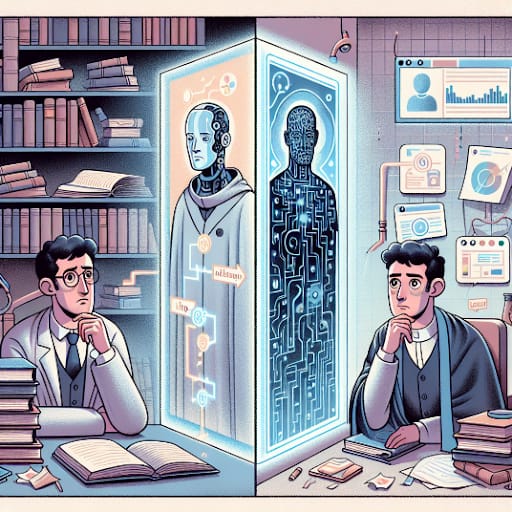
Figure 1

Figure 2

Figure 3
References
D’Agostino, Susan (September 13, 2023) Why Professors Are Polarized on AI. Inside
Higher Ed. https://www.insidehighered.com/news/tech-innovation/artificial-
intelligence/2023/09/13/why-faculty-members-are-polarized-ai
García-Peñalvo, Francisco José (2024) Generative Artificial Intelligence and Education:
An Analysis from Multiple Perspectives. Education in the Knowledge Society 25 e31942.
DOI:10.14201/eks.31942. https://www.proquest.com/docview/3117332789?pq-
origsite=gscholar&fromopenview=true&sourcetype=Scholarly%20Journals
Hamid, Rahem D. and Schisgall, Elias J. (June 28, 2023) Nearly Half of Surveyed
Faculty Pessimistic on AI Impact in Higher Ed. The Harvard Crimson.
https://www.thecrimson.com/article/2023/6/28/faculty-survey-5-ai/
Jamie Shinhee Lee is a Professor of Linguistics at the University of Michigan-Dearborn
and an editor of World Englishes and Digital Media, English in Asian Popular Culture
(with Andrew Moody) and World Englishes in Pop Culture (with Yamuna Kachru). Her
research interests include sociolinguistics of globalization, English in Korea, language
and popular culture, bilingualism, and Korean pragmatics/discourse analysis.