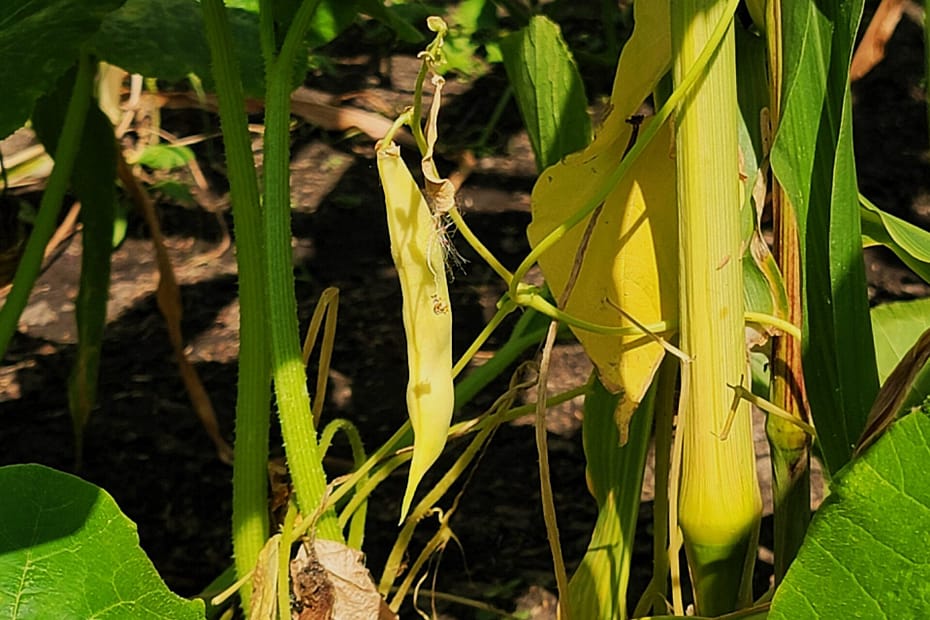

I have a little over 15 minutes before my office hours start so I head out of the CASL building to do a quick walk around campus. It’s nearing the middle of September already but the weather is like the best summer day in Michigan: clear, dry, and sunny. Instead of taking the diagonal route to the natural sciences building (NSB), I turn left, walk along the field with late summer grasses, turn right and head toward the back of NSB, or the space between that and Science Faculty Center (SFC) to look at the gardens: the Native medicinal plants and the Three Sisters. Black-eyed Susans and Joe Pye weed, sweetgrass, blue lobelia, milkweed and more, they’re all tagged with their names though eventually there will be larger signs with more info including traditional uses. And just on the other side of the sidewalk, the Three Sisters garden with Bear Island Flint Corn, Mskodiismin or Odawa Bean, and Gete-okosimin yellow squash, both gardens planted this past spring under the direction of Shiloh Maples, Anishinaabe community organizer, seed keeper, storyteller, and educator.*
With a group of others, faculty and students, I helped pull out weeds and put in seeds, and now the corn is taller than me, the huge leaves of the squash spread around and bordering the square space of the garden that’s nestled in the corner between the doors and main wall of the NSB building. On some of the corn stalks I can see the thin vines and soft leaves of bean plants spiraling up, encircling the corn in an embrace, the corn giving the beans a natural ladder to climb.
In her chapter on “The Three Sisters” in Braiding Sweetgrass–this year’s UM-Dearborn campus community read–Robin Wall Kimmerer writes:
At the height of the summer, when the days are long and bright, and the thunderers come to soak the ground, the lessons of reciprocity are written clearly in a Three Sisters garden. Together their stems inscribe what looks to me like a blueprint for the world … The corn stands eight feet tall; rippling green ribbons of leaf curl away from the stem in every direction to catch the sun. No leaf sits directly over the next, so that each can gather light without shading the others. The bean twines around the corn stalk, weaving itself between the leaves of corn, never interfering with their work. In the spaces where corn leaves are not, buds appear on the vining bean and expand into outstretched leaves and clusters of fragrant flowers. The bean leaves droop and are held close to the stem of the corn.
Spread around the feet of the corn and beans is a carpet of big broad squash leaves that intercept the light that falls among the pillars of corn. Their layered spacing uses the light, a gift from the sun, efficiently, with no waste. The organic symmetry of forms belongs together; the placement of every leaf, the harmony of shapes speak their message. Respect one another, support one another … and there will be enough for all. (131-132)
In addition to the plants growing together above ground, according to Kimmerer, they also cooperate underground, like the way the beans have the “ability to take nitrogen from the atmosphere and turn it into usable nutrients” (133) and so “when a bean root meets a microscopic rod of Rhizobium underground, chemical communications are exchanged … The bean will grow an oxygen-free nodule to house the bacterium and, in return, the bacterium shares its nitrogen with the plant. Together, they create nitrogen fertilizer that enters the soil and fuels the growth of the corn and the squash, too” (134).
And when eaten together, the corn, beans, and squash provide nutrients to humans in the forms of starch, protein, and vitamins. The diverse roles of these plants from seed to harvest and based on knowledge thousands of years old, even now potentially serving as, “a new metaphor for an emerging relationship between indigenous knowledge and Western science, both of which are rooted in the earth” (139). The plants nurture each other, flourish, and provide healthy sustenance for the humans who tend them.
I love sweet corn in the summer: eaten straight from the cob, mixed into salads with summer tomatoes and red onion or with pasta and basil. And reading Kimmerer makes me think more deeply about industrial monoculture farming, the hundreds and thousands of acres of not only single crops of corn, but corn made from patented, engineered seeds further narrowing the interplay between plants, land, and people. The Three Sisters garden is evidence of an ancient and vastly different worldview, a vision for a world that values “a polyculture of complementary knowledges,” as Kimmerer writes, “and so all may be fed” (139).
Running out of time, I head into and through the NSB and across toward the library, passing by a sign marking a Native Planting Restoration Project which transplanted “white oak, red oak, red maple, tulip, and redbud” trees as well as “pollinators and native prairie plants.” I walk by patches of goldenrod spread around the fields, seen almost everywhere it can grow at this time of year. Early in Braiding Sweetgrass, in “Asters and Goldenrod,” Kimmerer introduces us to the ideas she’s bringing together in the book. Rooted in her personal journey of recognizing beauty in the plant world and curious to learn the science, she heads to college to study botany, where it’s quickly made clear to her that beauty isn’t science:
In moving from a childhood in the woods to the university I had unknowingly shifted between worldviews, from a natural history of experience, in which I knew plants as teachers and companions to whom I was linked with mutual responsibility, into the realm of science. The questions scientists raised were not “Who are you?” but “What is it?” No one asked plants, “What can you tell us?” The primary question was “How does it work?” The botany I was taught was reductionist, mechanistic, and strictly objective. (41-42)
Integral to this journey and throughout this book of personal narrative essays is reflection on her Indigenous family, culture, language, and history along the way. As she writes:
To walk the science path I had stepped off the path of indigenous knowledge. But the world has a way of guiding your steps. Seemingly out of the blue came an invitation to a small gathering of Native elders, to talk about traditional knowledge of plants … a Navajo woman without a day of university botany training in her life—spoke for hours … One by one, name by name, she told of the plants in her valley. Where each one lived, when it bloomed, who it liked to live near and all its relationships, who ate it, who lined their nests with its fibers, what kind of medicine it offered. She also shared the stories held by those plants, their origin myths, how they got their names, and what they have to tell us. She spoke of beauty. (44)
In the essay she speaks as a Native person and scientist, the essay itself a journey from self doubt and the limiting nature of conforming to scientific practices while leaving the larger indigenous worldviews behind to recognizing how these actually and necessarily work together:
As it turns out, though, goldenrod and asters appear very similarly to bee eyes and human eyes. We both think they’re beautiful. Their striking contrast when they grow together makes them the most attractive target in the whole meadow, a beacon for bees. Growing together, both receive more pollinator visits than they would if they were growing alone. (46)
“Why are they beautiful together?” she asks, basically the same question she posed in her initial college interview when asked why she wanted to study botany. She’s reconstructed a version of her years-long path for readers into this vivid and poetic short essay, which feels like a thesis for the whole book and its many literal and figurative applications and interpretations, explaining, “When I stare too long at the world with science eyes, I see an afterimage of traditional knowledge. Might science and traditional knowledge be purple and yellow to one another, might they be goldenrod and asters? We see the world more fully when we use both” (46).
Within science and Indigenous knowledges are worlds of discoveries, insights, facts, observations, practices, solutions, ways of healing, and more. We see and experience the world, and maybe have greater potential to heal the world, when reciprocity and cooperation between science and nature–including plants, animals, all other species, humans and our larger climate concerns–are valued and protected instead of foregrounding humans as dominating and controlling species considered “less than” us.
I haven’t seen any asters on campus–though they could be somewhere I’ve missed. But the many goldenrods glow in the unusually warm late summer sun, the tall grasses sway in a light breeze, other flowers scattered around still holding vibrant colors.
The plants like our campus offer lessons of contrast, of the necessary benefits of the beauty of diversity. Like the way the late summer flowers offer us and the bees sustenance, the corn and beans and squash ensuring their own, and our, survival, Kimmerer encourages us to step outside and really see what’s around us.
*We planted the Three Sisters garden on campus under the direction of Shiloh Maples, Anishinaabe community organizer, seed keeper, storyteller, and educator invested in Indigenous food sovereignty and food justice, and funded by a grant from the Inclusive History project. Here’s the more detailed description of the seeds that she shared with us:
The first sister (Corn or Maize) is Bear Island Flint Corn, a traditional variety grown by the Anishnaabeg. It originated on one of the islands in Leech Lake, Minnesota. The second sister (Bean) is a Mskodiismin or Odawa Bean. Not fully a bush bean nor a heavy vining bean it is a wonderful complement to the Bear Island Corn. The third sister (squash) is Gete-okosimin squash. Gete-okosimin’ is a pre-Columbian squash originally grown by Native Americans in the Wisconsin area. Until recently believed to be extinct, the squash is making a comeback, thanks to ancient seed unearthed by archaeologists in 2008 during an archaeological dig on a Menominee reservation near Green Bay, Wisconsin. A clay vessel, about the size of a tennis ball, was recovered containing the seed of what was to become known as ‘Gete-okosimin’ squash. The artifact was carbon-dated to about 850 years ago.
Links and Resources:
Find more about how to access the book and events on campus for the UM Dearborn Community by checking out the Community Read website.
You can find information developed by faculty at Dearborn for teaching with essays from the book on the Teaching with Braiding Sweetgrass website.
“Asters and Goldenrod” could be assigned on its own (such as in the first year classroom) or paired with other chapters such as “The Teachings of Grass,” “The Three Sisters,” or “The Council of Pecans.” Also see the helpful resource The 1817 Project: Land, Culture, Memory, and Repair.
Find the gardens and other Sustainability and Environmental Wellness areas on campus with the UM-Dearborn Campus sustainability Map.