


Authored by Maya Barak
This summer I was fortunate to participate in the Hub’s 2026 Small Changes Course Improvement Studio. Grounded in the Community of Inquiry Framework (CoI), the Studio was organized into three interdisciplinary faculty working groups: social presence, cognitive presence, and teaching presence. According to the CoI Framework, these three components are the building blocks of engaged and meaningful collaborative learning experiences, with each one facilitating the other as visualized in The Community of Inquiry venn diagram below:
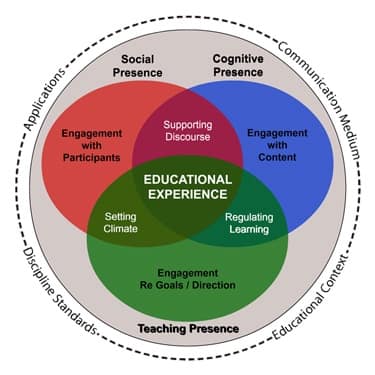
The original image is located at The Community of Inquiry and licensed under the CC-BY-SA International 4.0 license.
Social presence centers learners’ sense of connection to one another, their professors, and course content, including their ability to project themselves and feel seen and valued. Cognitive presence encompasses the ways in which learners engage with course content through critical thinking, reflection, and meaning-making. Teaching presence refers to how we, as teachers, show up to and in our courses, including through materials, communications, assignments, assessments, and feedback. Ultimately, the CoI Framework offers an opportunity to rethink how we do teaching and learning in higher ed, including the assumptions we make and the things we may take for granted.
I was part of the social presence group, originally planning to rethink a few small changes for the Introduction to Criminal Justice course in our Criminology, Law, and Criminal Justice Program. For a course like this, which primarily attracts incoming freshmen and serves as a gateway to the major, strong social presence is crucial to community building, student success, and retention. More specifically, in my course, I hoped a focus on social presence would help facilitate the following goals:
- Building relationships with one another as a community of learner-teachers and teacher-learners;
- Gaining respect for oneself and one’s peers as experts in our own lived experiences, recognizing that knowledge comes alive through our shared experience over the course of the semester and this is all part of growing into our academic and professional selves; and,
- Fostering a sense of safety, trust, and wonder (or, embracing inquisitiveness and fostering interests) in the classroom.
As I sat down to explore how to incorporate social presence in my Intro to CJ course, I realized I needed to take a step back and do a “social presence inventory” of sorts. What, if anything, was I already doing to facilitate social presence in this class and, for that matter, across the various courses I teach? Before “reinventing the wheel,” so to speak, I wondered what I could leverage, adapt, and innovate from across my roster of courses in order to strengthen social presence. This workshop was, after all, about small changes. Perhaps simply approaching social presence intentionally, as pedagogy, would allow me to adapt my course without too much of a heavy lift.
Not having conducted a social presence inventory before, nor any sort of pedagogical inventory, I decided to draw on my qualitative methods training and conduct a content analysis (or, a systematic survey of how often and in what categories things occur within texts) of my syllabi. Drawing on the CoI Framework’s definition of social presence, I reviewed my syllabi for assignments and practices that facilitate building connections, community, and trust. Here’s what I came up with:
Assignments
- Slack Discussion Posts (in which students engage in semi-synchronous dialogues about course content)
- Resources:
- Possible enhancement: I wonder what it would look like to invite multimedia discussion responses that integrate multiple formats (e.g. written, verbal, images, video, action)?
- Slack Weekly Wellness Practice (in which students explore a variety of wellness practices to support their well-being and expand their academic success toolkits)
- Resource: “Pedagogy of healing: Bearing witness to trauma and resilience” – Mays Imad, Inside Higher Ed
- Possible enhancement: I wonder if it would be possible for students to try some wellness practices in community (e.g. partners, small groups, as a whole class)?
- “TikTok” Videos + Student Film Festival (in which students teach each other about their topics through individual videos I organize into a film festival, complete with student-sourced award categories and a viewers’ choice award)
- Resource: “Building community through collaboration at the start of the school year” – Kim Lee, Edutopia
- Possible enhancement: I wonder what it would take to have students organize and run the film festival and invite folks outside the course to join us?
Practices
- Individual student welcome message (in which I personally message each student during the first week of class)
- Resources:
- Possible enhancement: I wonder how students might respond to a partner activity in which they spend an hour getting to know one another, create an artifact that represents the other person (e.g. creative writing, artwork, video, song, etc.), then present the artifact to the class?
- Dr. Barak’s Course Policies (in which I lay out course expectations and norms for the semester)
- Resources:
- “Building community and setting norms during the first day of class” – Stanford’s Graduate School of Education;
- “Examples of guidelines for discussion” – UM’s Center for Research on Learning & Teaching (CRLT);
- “Establishing community agreements and classroom norms” – Cornell’s Center for Teaching Innovation
- Possible enhancement: I wonder what it would be like to create these together as a class?
- Resources:
- In-class activities with varying levels of collective engagement (e.g. solo reflection and invitation to share, like inviting students to “draw crime” and then show the class; solo creation that I compile into group product, like turning individual haikus into word clouds; small group activities, like picking a criminological theory and applying it to our campus with the goal of enhancing campus safety; or “layered” activities in which I or students compile individual creations into something larger together, like creating a Crim Theory Lotería Game with cards drawn by students to represent theories–new to Lotería? It’s a lot like Bingo!)
- Resources:
- Possible enhancement: I wonder what it would look like to create student groups that take turns being responsible for developing and leading these weekly exercises for the class?
- Assignment feedback (in which I offer students personalized feedback tied to assignment handouts/rubrics)
- Resource: “Being a warm demander: Challenging students’ with relationship-rich teaching and wise feedback” – Michelle Pacansky-Brock, California Virtual Campus Online Network of Educators
- Possible enhancement: I wonder how students would receive feedback organized around a “thinking routine” adapted from Harvard’s Project Zero (e.g. directed response to prompt: what did you 1) notice, 2) feel, 3) wonder, and what does this 4) remind you of…
Now, these are not exhaustive lists. I conducted a preliminary review, but a deeper analysis would likely offer additional insights to rethink and enhance social presence in my courses. For example, transitioning from content analysis to a more nuanced discourse analysis–i.e. looking not only at what is incorporated into my courses, but how it is framed through written and verbal communications with learners–feels potentially useful. So does conducting parallel cognitive presence and teaching presence inventories, then cross-referencing to spot (and uplift) assignments and practices that tap into multiple types of presence. At the end of the day, conducting an inventory of my syllabi, in and of itself, is one small change I plan to carry with me into my semesterly course prep moving forward!
Please note that this work is licensed under a Creative Commons License more restrictive than the Hub Blog as a whole.
